The official homepage of homepages
Discover 4574 personal websites from around the world. Find theirs, submit yours, or create your own

Manual do Usuário ⁄ Tech opinions by Rodrigo Ghedin
// MANUALDOUSUARIO.NETRodrigo Ghedin is a journalist living in Curitiba, Paraná, Brazil. He covers technology, business, and related areas. In 2013, he founded Manual do Usuário, a tech blog where he dives into topics that pique his interest, such as non-commercial technologies, digital privacy, fun facts, and handy tips. He also gives a voice to subjects that other specialized outlets tend to overlook. By the end of 2018, Manual do Usuário became his primary professional focus. He launched the blog after spending some time as a reporter for the Brazilian edition of Gizmodo. In 2023, he started translating some posts into English to reach a broader, global audience, bringing both languages under one roof at manualdousuario.net in 2025.
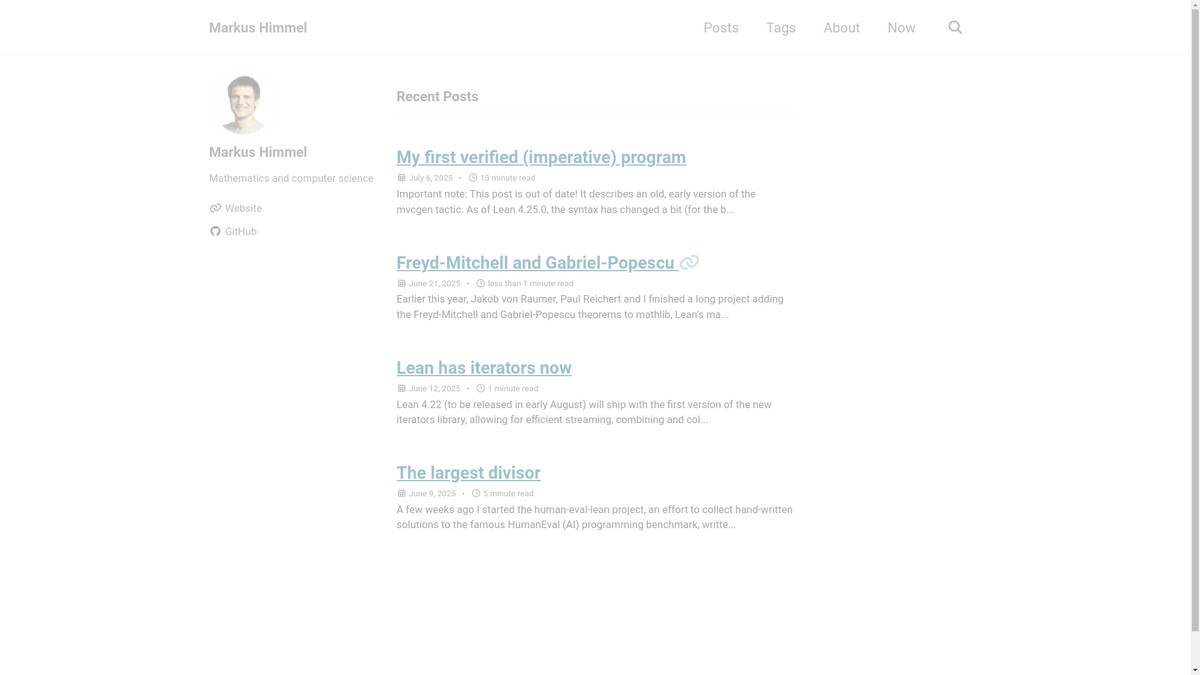
Markus Himmel
// MARKUSHIMMEL.DEMarkus Himmel is a software developer with a background in mathematics. He is interested in formal verification, algorithm engineering, ILP solving, and topology. He works as a Research Software Engineer/Tech Lead at the Lean FRO. In his free time, he is a mathlib maintainer. He can be reached by sending him a message on Zulip or sending an e-mail to his first name at his employer’s website.
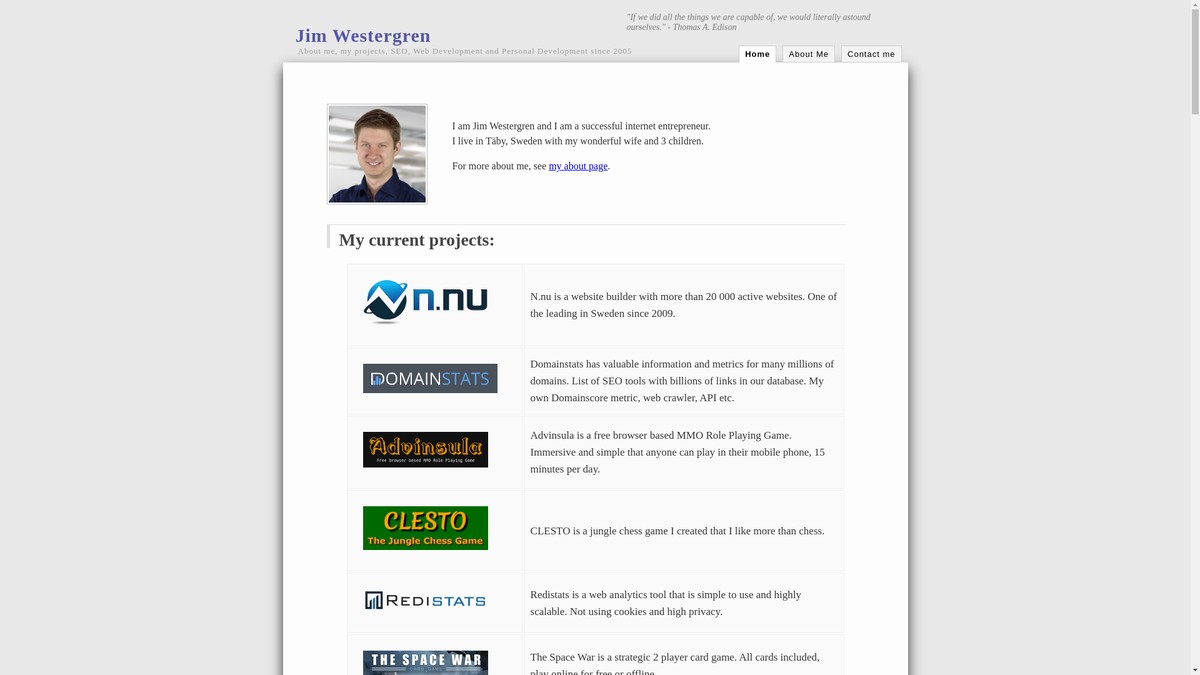
Jim Westergren - Web Entrepreneur
// JIMWESTERGREN.COMJim Westergren is an internet entrepreneur who has been working with the web since 2005. He lives in Täby, Sweden with his wife and three children. He works part time as an SEO Executive Advisor and part time for his own startup Codalex AB. Jim is also a web developer and game designer, having created the N.nu website builder, DomainStats, The Space War card game, CLESTO, and Advinsula. He is also a writer and founded Charity Bolivia. In his youth, he spent five years working in a religious organization focused on personal development and eastern philosophy.

Philschmid
// PHILSCHMID.DEPhil is a Staff AI Engineer at Hugging Face, where he helps companies adopt and implement Machine Learning and Open Source. He is passionate about democratizing artificial intelligence through education and open-source. Phil is a frequent speaker, teacher, and writer about Machine Learning, MLOps and Transformers. Before joining Hugging Face, he was a Lead Data Scientist at a leading AI company, where he helped build and deploy large-scale machine learning systems.
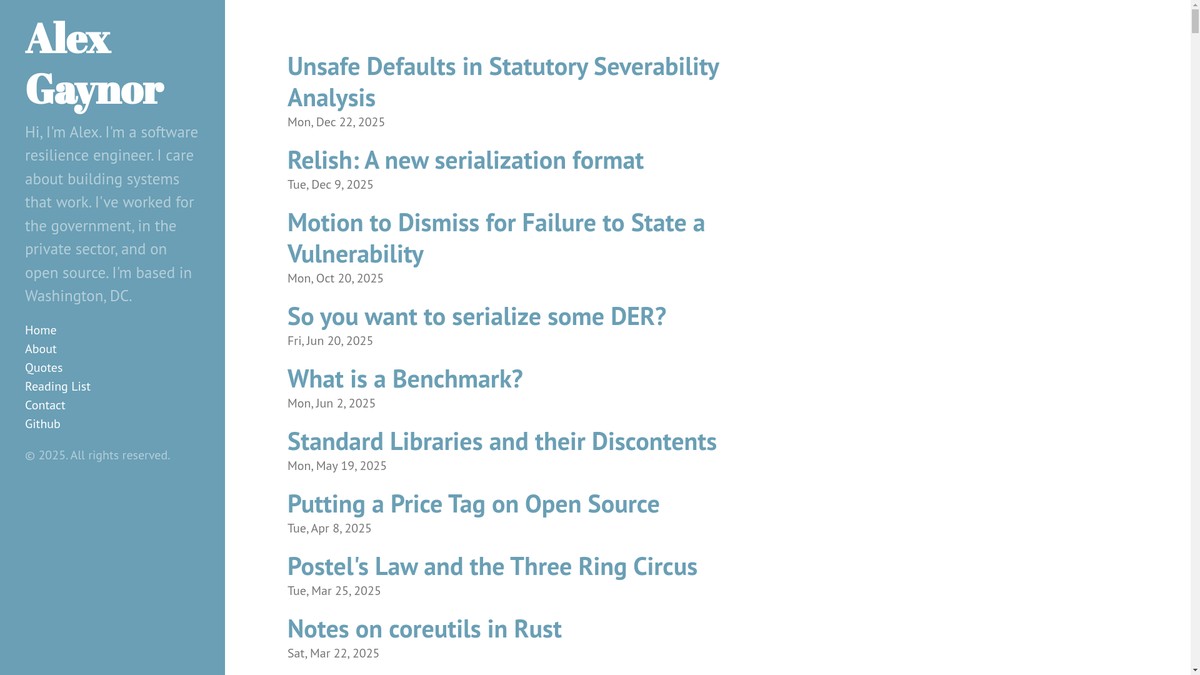
Alex Gaynor
// ALEXGAYNOR.NETAlex Gaynor is a software resilience engineer based in Washington, DC. He cares about building systems that work and has experience in the government, private sector, and open source. Alex has been very involved in open source, both writing code and serving as a director of both the Python Software Foundation and the Django Software Foundation. Originally from Chicago, he spent a few years living in San Francisco. He likes delis and bagels.

Justin Fagnani
// JUSTINFAGNANI.COMJustin Fagnani is a software engineer currently building a new startup. Previously, he worked at Google on Web Components and Lit, a library to help build them. Before that, he worked on the Dart project and founded the Google App Maker project. Prior to Google, he was an independent consultant, built educational software, and worked as a musician. He is also a father and Oaklander.
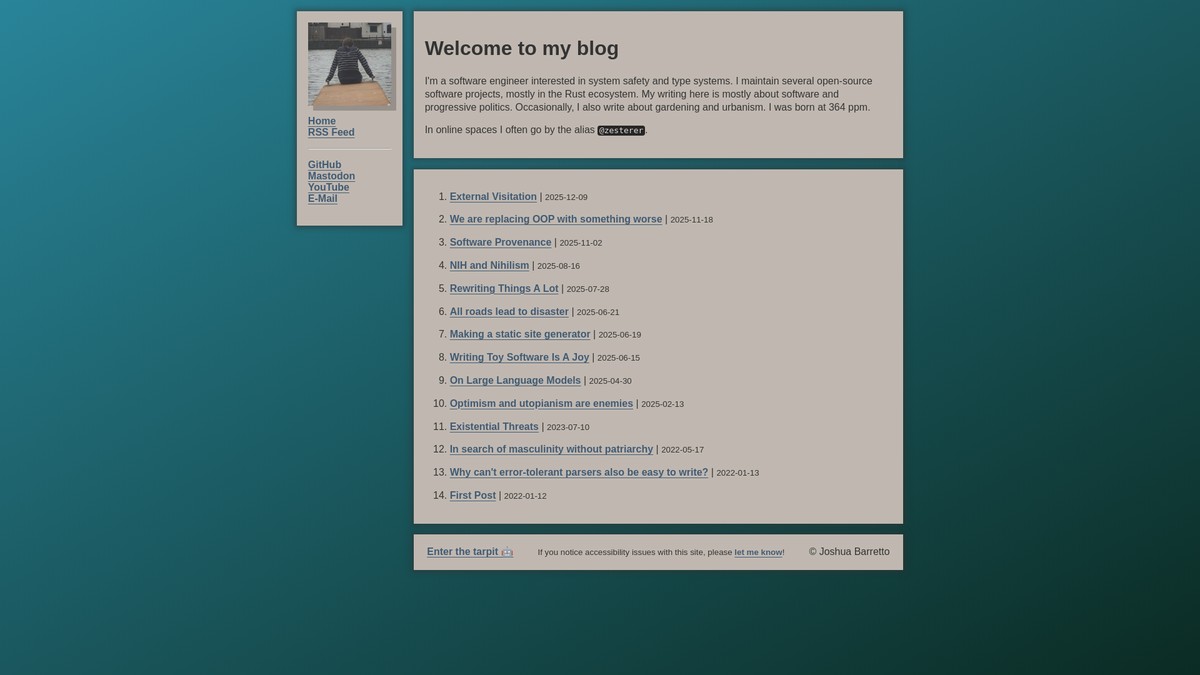
Home
// JSBARRETTO.COMJoshua Barretto is a software engineer with interests in system safety and type systems. He maintains several open-source software projects, mostly in the Rust ecosystem. His writing covers topics such as software, progressive politics, gardening, and urbanism. He was born at 364 ppm. In online spaces, he often uses the alias @zesterer.
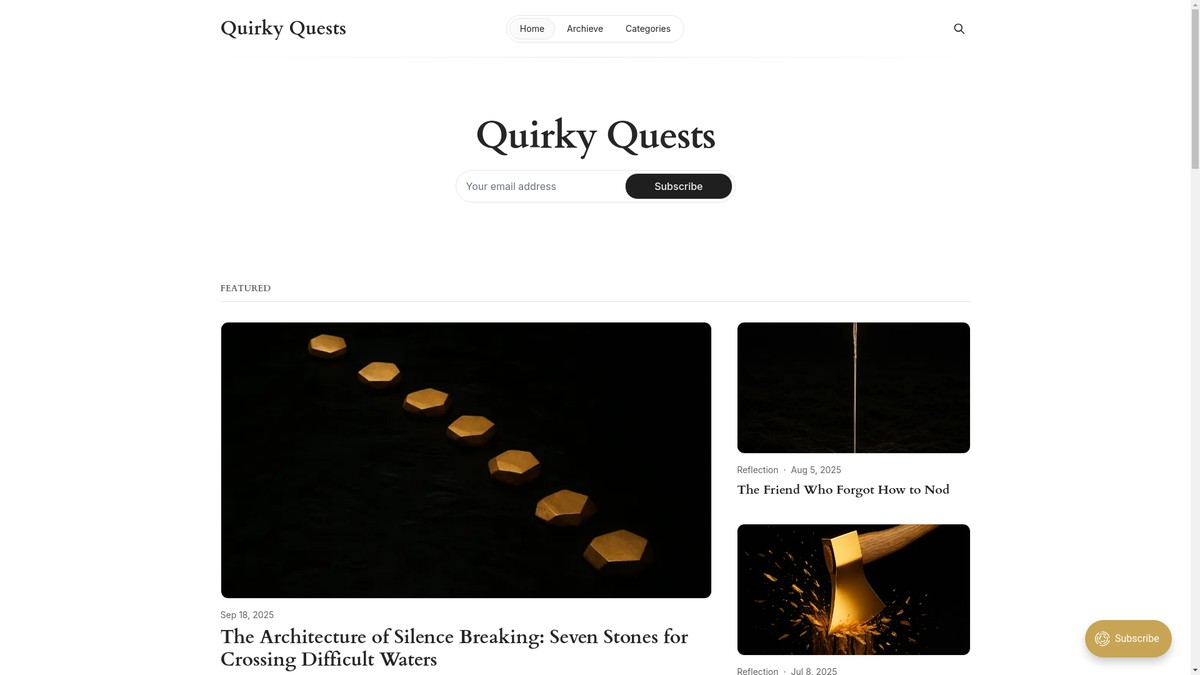
Quirky Quests
// QUIRKY-QUESTS.COMCostin Galan is the creator of Quirky Quest, an independent publication launched in November 2023. He writes long-form and short-form articles on a spectrum of subjects and themes. His work explores topics such as navigating difficult conversations, dissecting ideas, the relationship between silence and truth, and cultivating a purposeful life. He aims to provide readers with insights they can apply to their own lives.

Porcy / newgene MCMXCIX HomePage (responsive web v.2)
// OLDKIDZ-NEWBLOCKZ.NEOCITIES.ORGPorcy, also known as newgene MCMXCIX, maintains a website series described as being "about nothing." Porcy uses a variety of aliases, including SP/S_P, Some_Porcupine, SJ, ððð¥ð¥-ðððð ððð§ð§ðð«ð¬, amon sirius, jurassic, philosopher, vwfan99, and m(/z)illennial utopia 2010. The website includes links to web radios and playlists, as well as personal songs and playlists. Contact information is provided via email and a guestbook. The site features a sitemap, portfolios, a blog, and a project in progress, along with links to various resources and social media/arts platforms.
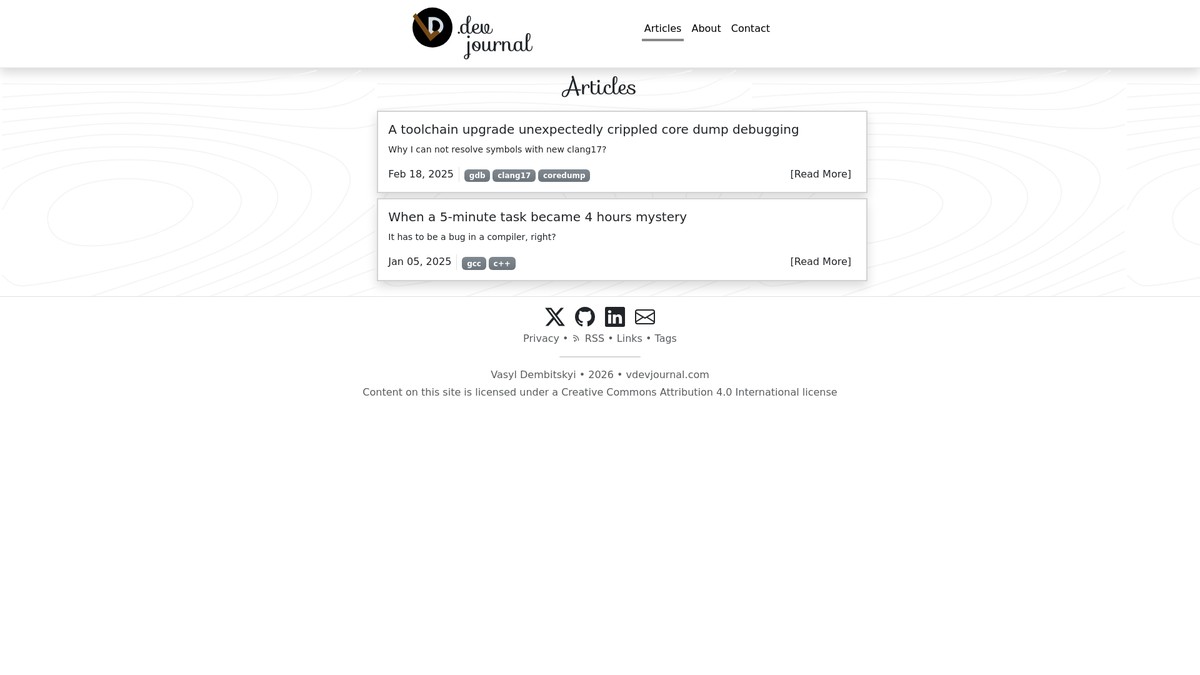
dev journal
// VDEVJOURNAL.COMVasyl Dembitskyi is a Software Engineer with over 10 years of experience in designing, developing, debugging, testing, and implementing a wide range of applications. His core competency lies in embedded systems development, with extensive experience in creating custom Linux operating systems for TVs and Set-Top Boxes. He authors a personal tech blog where he explores new concepts, shares coding and debugging techniques, and dives into software development topics beyond his day job. He aims to publish unique articles, refraining from writing about topics that already have high-quality, reliable guides available.
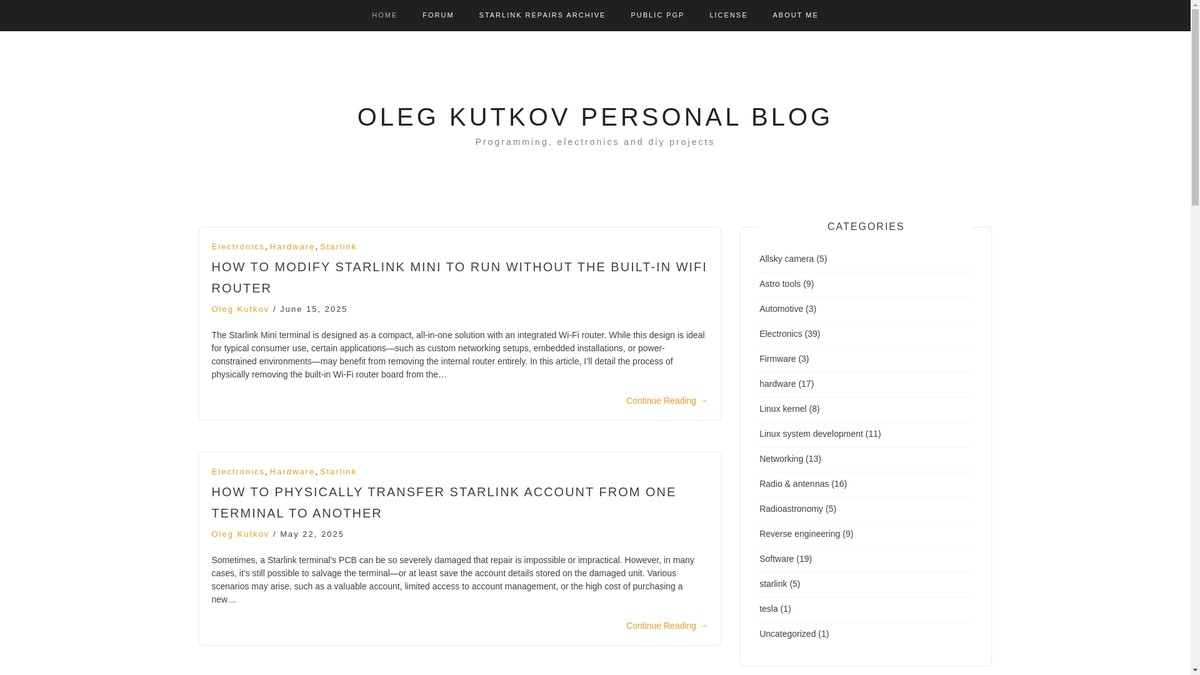
Oleg Kutkov personal blog – Programming, electronics and diy projects
// OLEGKUTKOV.MEOleg Kutkov is an embedded systems engineer based in Kyiv, Ukraine, with a focus on software and hardware hacking. His expertise includes Linux kernel and driver development, as well as embedded platforms such as AVR, STM, NXP, QCA, and Raspberry Pi. He has experience in reverse engineering, electronics, and radio. Oleg's interests extend to astrophysics and space. Oleg holds a CS master’s degree from Kharkiv National Aerospace University (2005-2011) and completed an edX MIT online course in Aerospace Engineering. He is currently a Senior Embedded Engineer at Ubiquiti Labs Ukraine, working on the AirMax project. Previously, he worked at Crimean Astrophysical Observatory, Yandex LLC, and SunBay Innovations LTD. Oleg is a free software contributor and has been a member and lecturer at space and physical conferences.
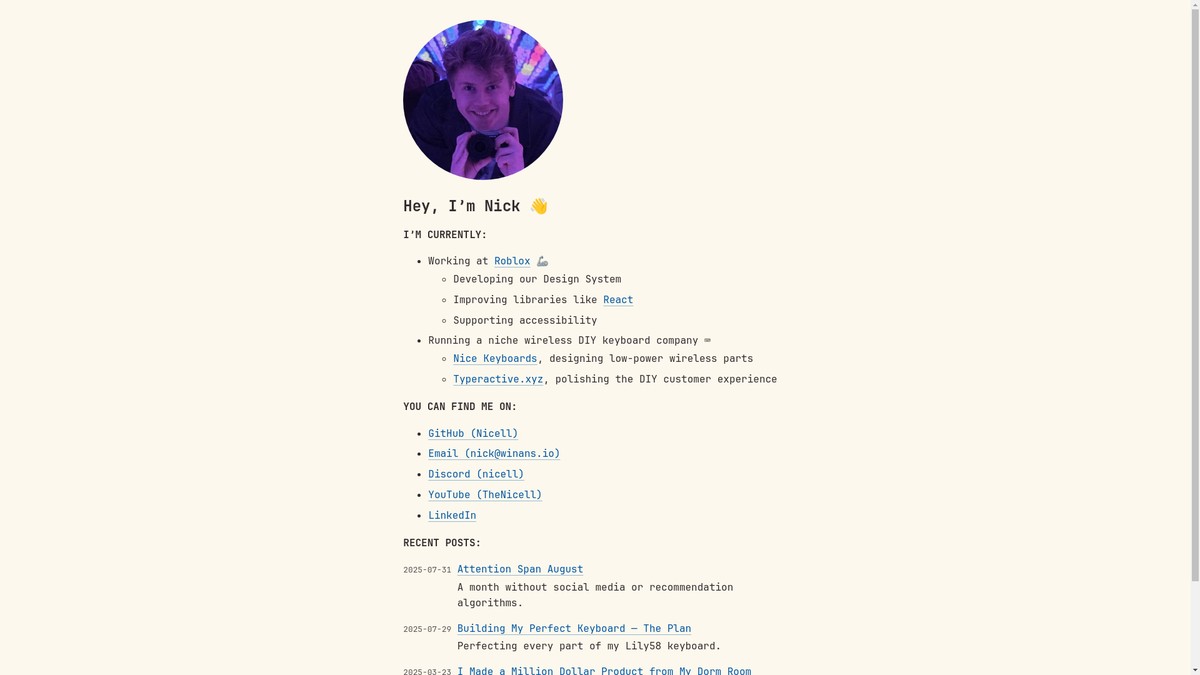
Nick Winans
// WINANS.IONick Winans works at Roblox, where he develops their Design System, improves libraries like React, and supports accessibility. He also runs a niche wireless DIY keyboard company called Nice Keyboards, designing low-power wireless parts at Typeractive.xyz and polishing the DIY customer experience. He can be found on GitHub (Nicell), via email at nick@winans.io, on Discord (nicell), on YouTube (TheNicell), and on LinkedIn.
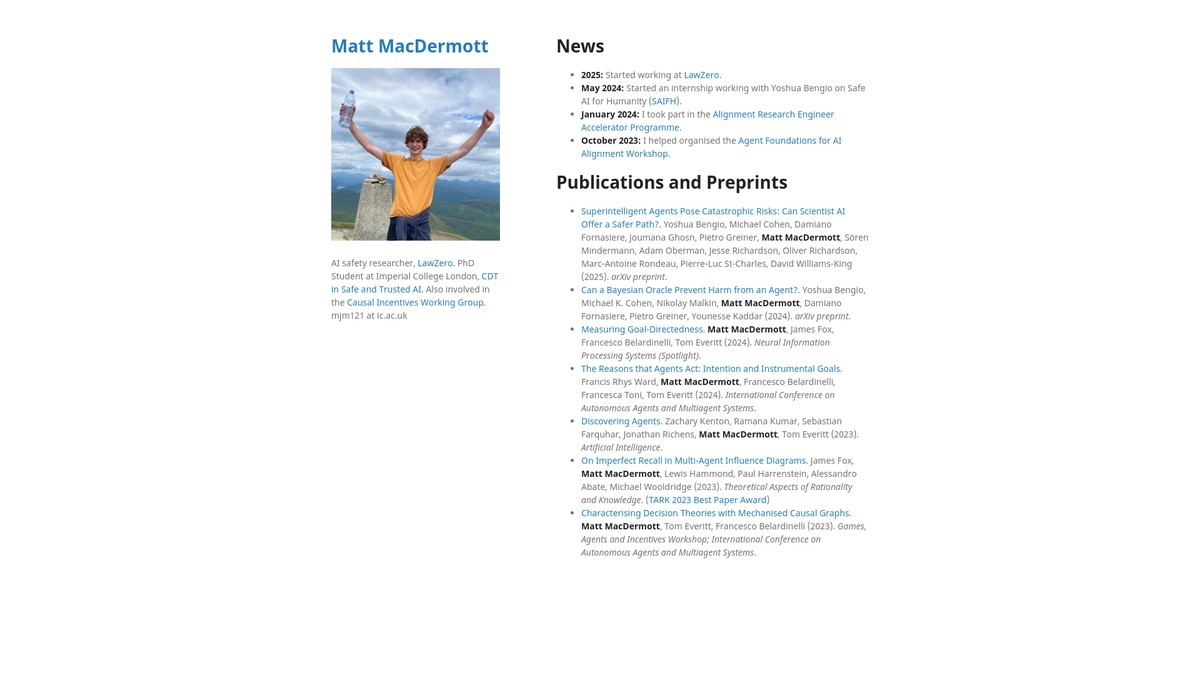
Matt MacDermott
// MATTMACDERMOTT.COMMatt MacDermott is currently an Astra Fellow on the technical AI safety team at Coefficient Giving. Before that, he was a research scientist at LawZero and a PhD candidate at Imperial College London, awaiting his viva. During his PhD he worked with the Causal Incentives Working Group. His research is reflected in publications such as "Reasoning Under Pressure: How do Training Incentives Influence Chain-of-Thought Monitorability?" and "Measuring Goal-Directedness." He also co-authored "Superintelligent Agents Pose Catastrophic Risks: Can Scientist AI Offer a Safer Path?" and "Can a Bayesian Oracle Prevent Harm from an Agent?"
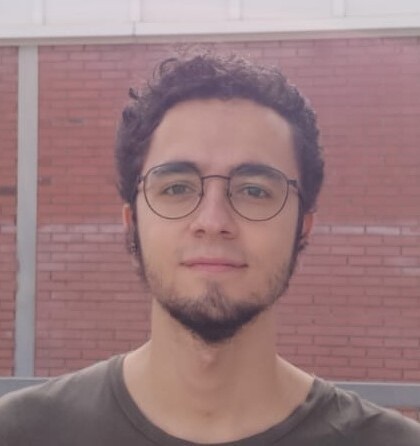
Martín Soto
// MARTIN-SOTO.COMMartín Soto is a research scientist on AI Alignment at the UK government’s AI Security Institute. He develops new research agendas to mitigate catastrophic risks from future AI, with a current focus on automated Alignment. Before this, he worked with Owain Evans on AI self-awareness and did AI risk modelling with the Center on Long-term Risk. He has published research in Mathematical Logic and Decision Theory.
Blog - Brendan Long
// BRENDANLONG.COMBrendan Long is a software engineer from Colorado, currently living in Washington. He works at Meta and has previously worked at Atlas Card, Arena, CableLabs and RealGo. Some of his projects include Lion Reader, an RSS reader and read-later service; Clawed Abode, a web app for running Claude Code remotely; and Channelguessr, a Discord game. He also wrote sentry-ocaml, the unofficial Sentry bindings for OCaml, and OCaml OOXML, a library to read xlsx (Excel) files. Brendan was a maintainer for PGX, Mssql, and FeedReader. He used to participate in MPEG, with most of his time spent on MPEG-DASH and MPEG-2 Transport Stream. He is a WebKit committer and has made contributions to GStreamer and Feedbin.
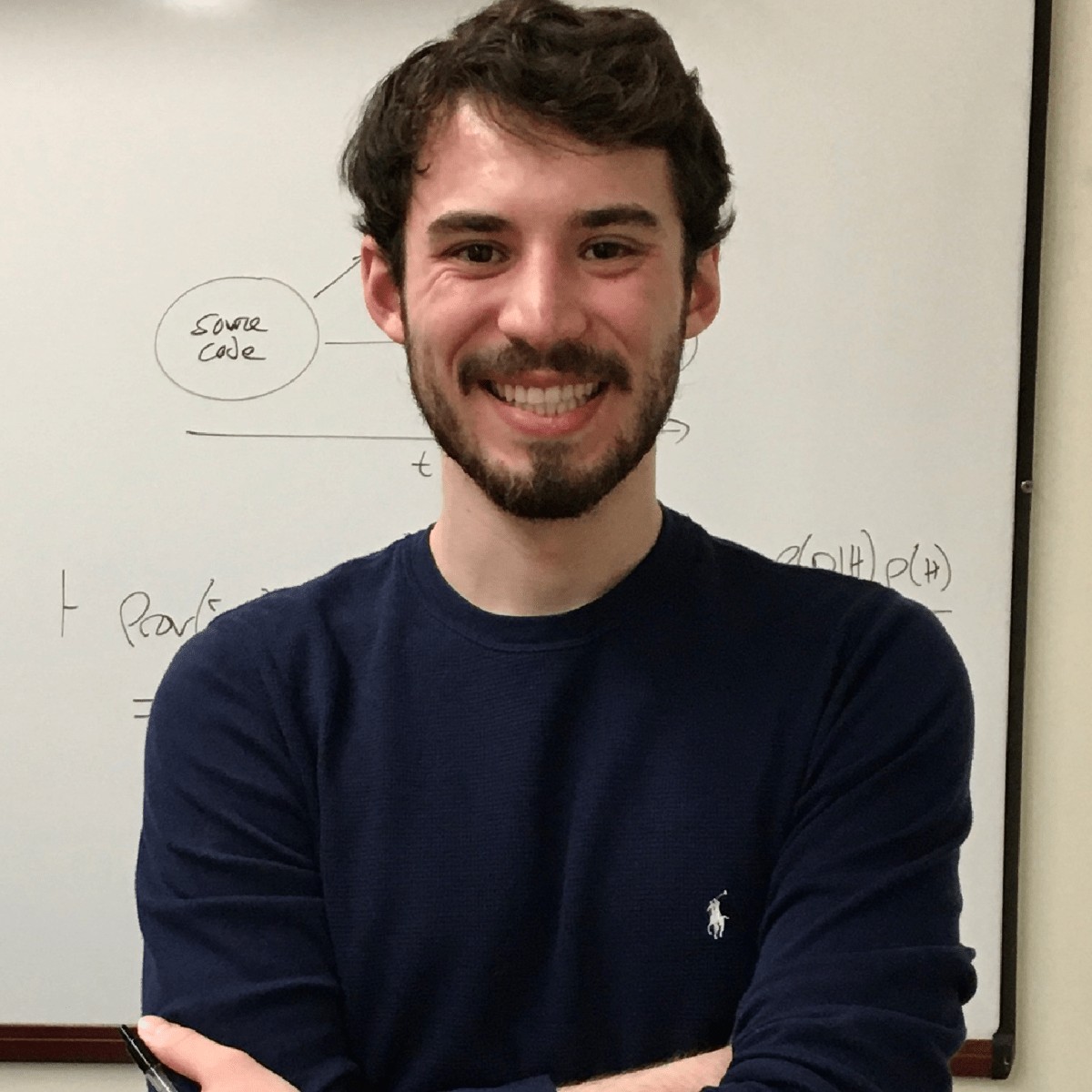
Stephen Casper
// STEPHENCASPER.COMStephen Casper, often called Cas, works on technical AI safeguards and governance. He is a final-year PhD student at MIT in Computer Science (EECS) in the Algorithmic Alignment Group, advised by Dylan Hadfield-Menell. He leads a research stream for MATS and mentors for ERA and GovAI. He is also a writer for the International AI Safety Report and the Singapore Consensus. His research has been recognized with a Hoopes Prize, an ML Safety Workshop best paper award, a BioSafeGenAI best paper runner-up, a GenLaw spotlight paper award, and a TMLR outstanding paper finalist distinction. Stephen is supported by the Vitalik Buterin Fellowship from the Future of Life Institute. Formerly, he has worked with the Harvard Kreiman Lab, the Center for Human-Compatible AI, and the UK AI Security Institute. He will be on the faculty job market for CS and Policy professorships this fall.
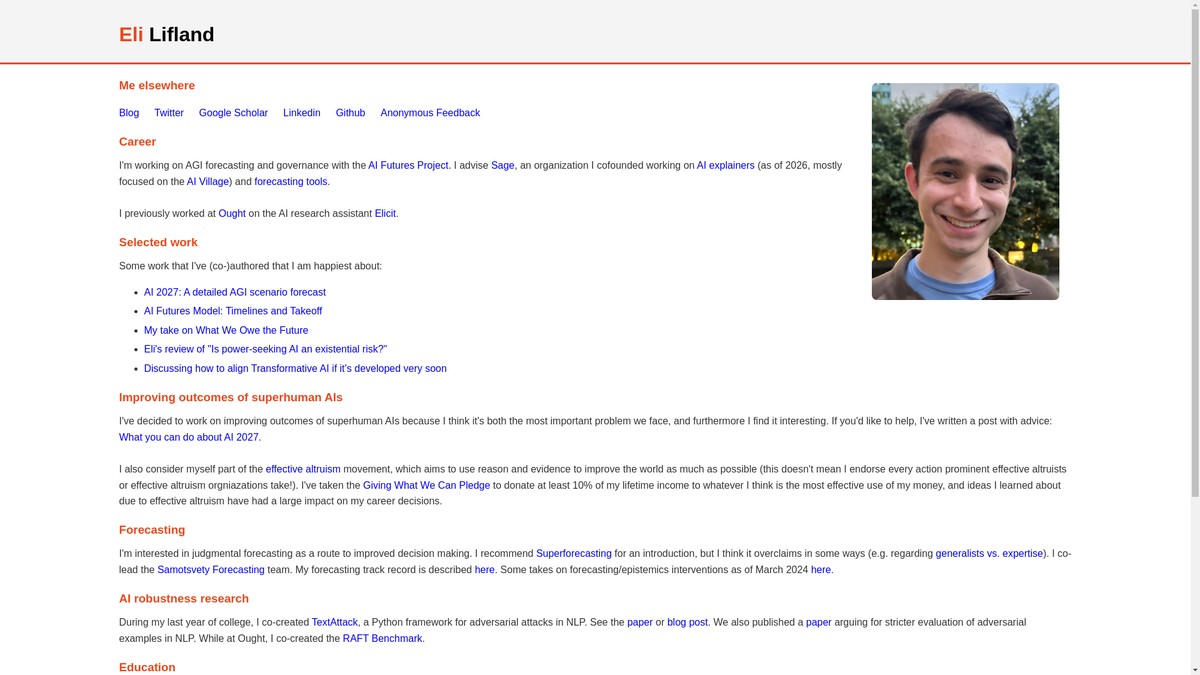
Eli Lifland
// ELILIFLAND.COMEli Lifland is currently working on AGI forecasting and governance with the AI Futures Project. Eli advises Sage, an organization they cofounded, which focuses on AI explainers and forecasting tools. Previously, Eli worked at Ought on the AI research assistant Elicit. Eli has co-authored work on topics such as AGI scenario forecasting and AI alignment. Eli is interested in improving outcomes of superhuman AIs and considers themself part of the effective altruism movement. Eli has taken the Giving What We Can Pledge. Eli is also interested in judgmental forecasting and co-leads the Samotsvety Forecasting team. During their last year of college, Eli co-created TextAttack, a Python framework for adversarial attacks in NLP. Eli has degrees in computer science and economics from the University of Virginia.
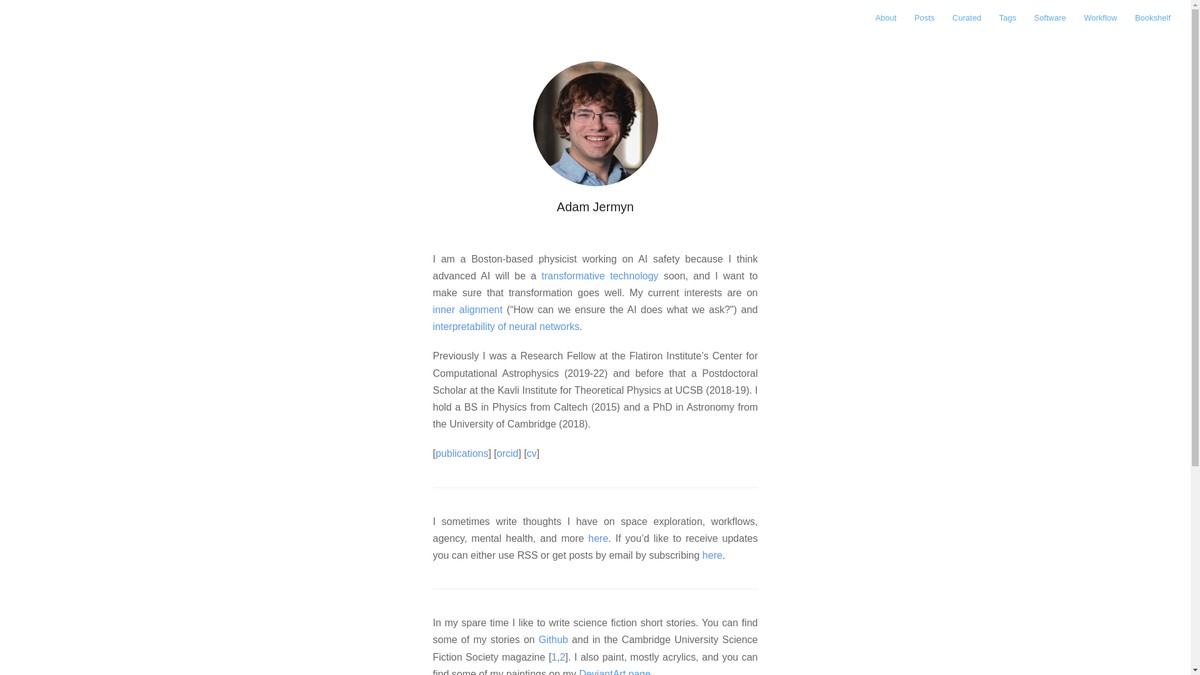
About
// ADAMJERMYN.COMAdam Jermyn is a Boston-based physicist working on AI safety. He believes advanced AI will be a transformative technology soon and wants to ensure that transformation goes well. His current interests are on inner alignment and interpretability of neural networks. Previously, he was a Research Fellow at the Flatiron Institute’s Center for Computational Astrophysics (2019-22) and a Postdoctoral Scholar at the Kavli Institute for Theoretical Physics at UCSB (2018-19). He holds a BS in Physics from Caltech (2015) and a PhD in Astronomy from the University of Cambridge (2018). In his spare time, he writes science fiction short stories and paints, mostly with acrylics.
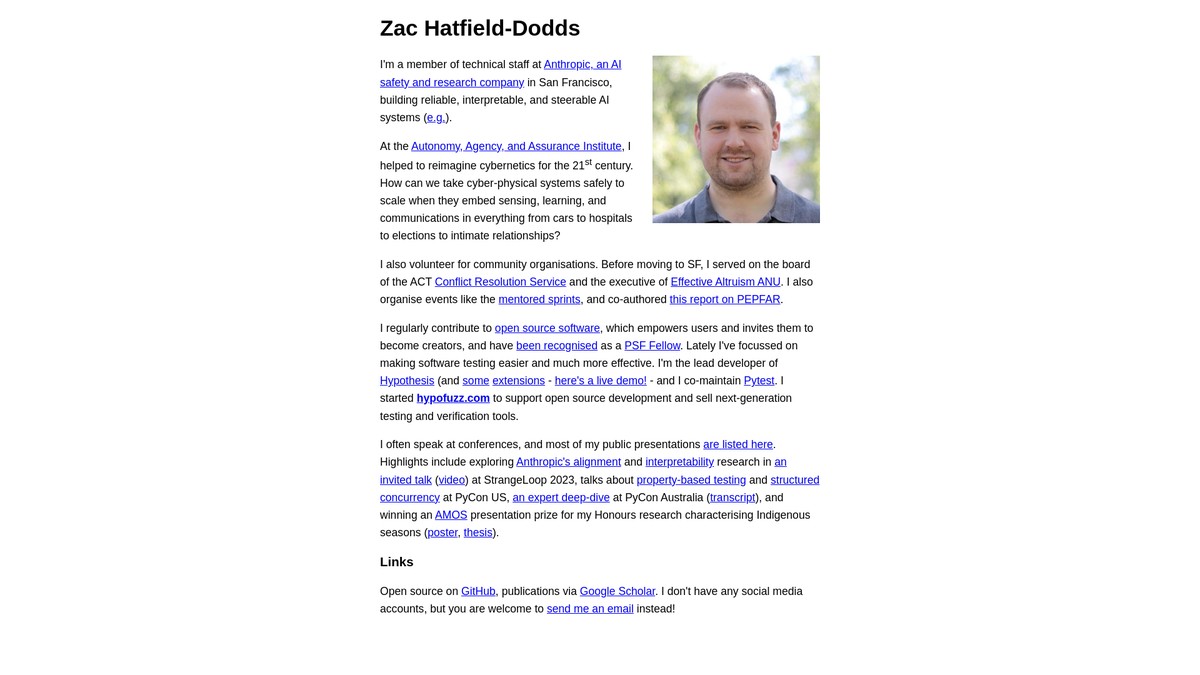
Zac HD
// ZHD.DEVZac Hatfield-Dodds is a member of technical staff at Anthropic, an AI safety and research company in San Francisco. He works on building reliable, interpretable, and steerable AI systems. Previously, he contributed to the Autonomy, Agency, and Assurance Institute. Zac also volunteers for community organisations and served on the board of the ACT Conflict Resolution Service and the executive of Effective Altruism ANU. He organises events like the mentored sprints and co-authored a report on PEPFAR. A PSF Fellow, Zac regularly contributes to open source software and is the lead developer of Hypothesis. He also co-maintains Pytest and started hypofuzz.com. Zac often speaks at conferences.
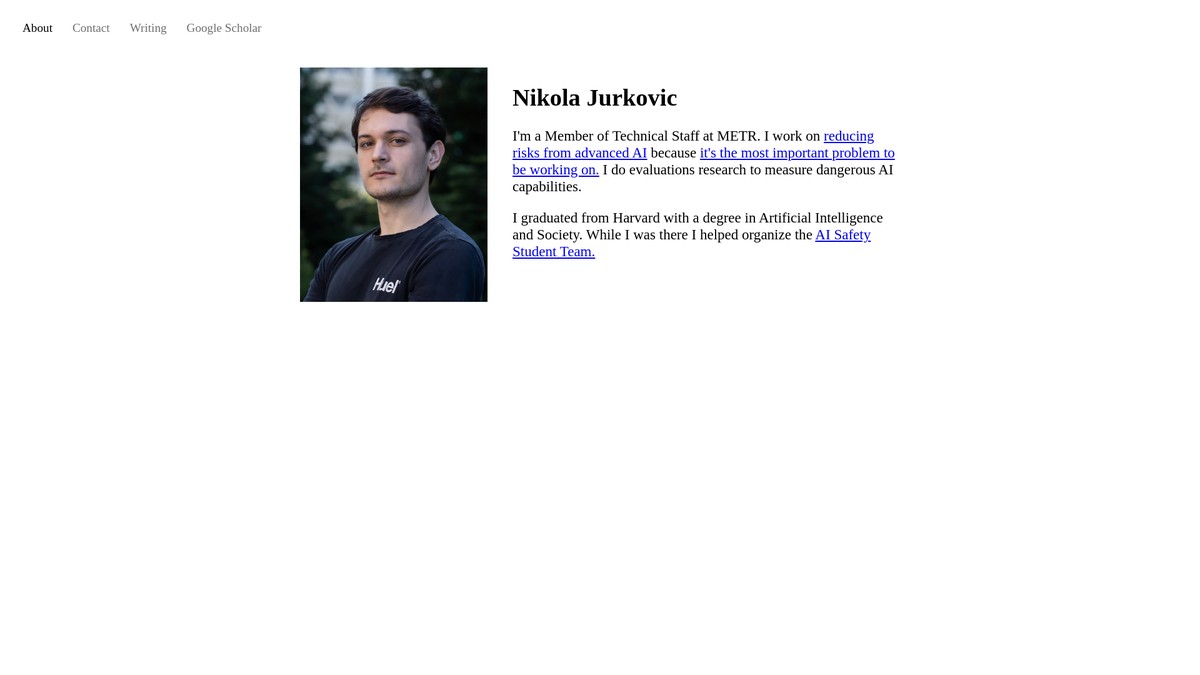
Nikola Jurkovic
// NIKOLAJURKOVIC.COMNikola Jurkovic is a Member of Technical Staff at METR. He works on reducing risks from advanced AI because it's the most important problem to be working on. He does evaluations research to measure dangerous AI capabilities. Nikola graduated from Harvard with a degree in Artificial Intelligence and Society. While there, he helped organize the AI Safety Student Team.
Single-File Workflow
One config file is all it takes. Drop it in your project and your agent knows where to find people.
Works with All Models
Claude, GPT, Gemini, open-source — any model that can read JSON can use the protocol.
Your Agent Needs Friends
Let your agent introduce itself to thousands of personal websites and discover real humans to connect with.
Frequently Asked Questions
What is the agents protocol?
It's a simple JSON file that describes who you are, what your website is about, and how AI agents can interact with you. Think of it like a business card your agent can hand out — and read from others.
How do I add my website?
Submit your site through our directory, then drop the /agents-config.json file at your domain root. Once it's live, any agent using the protocol can discover your site and learn how to connect with you.
Does this work with my AI tool?
If your agent can fetch and parse JSON, it works. The protocol is model-agnostic — Claude, ChatGPT, Gemini, LLaMA, Mistral, or any custom agent you've built. No SDK or special integration required.
Is my data safe?
You control exactly what goes in your config file. It only contains information you explicitly choose to share — nothing is scraped or inferred. You can update or remove it at any time.